
.png)


.png)

.png)

“ 2 Reactive dogs go for a walk” – the back-story & our dogs
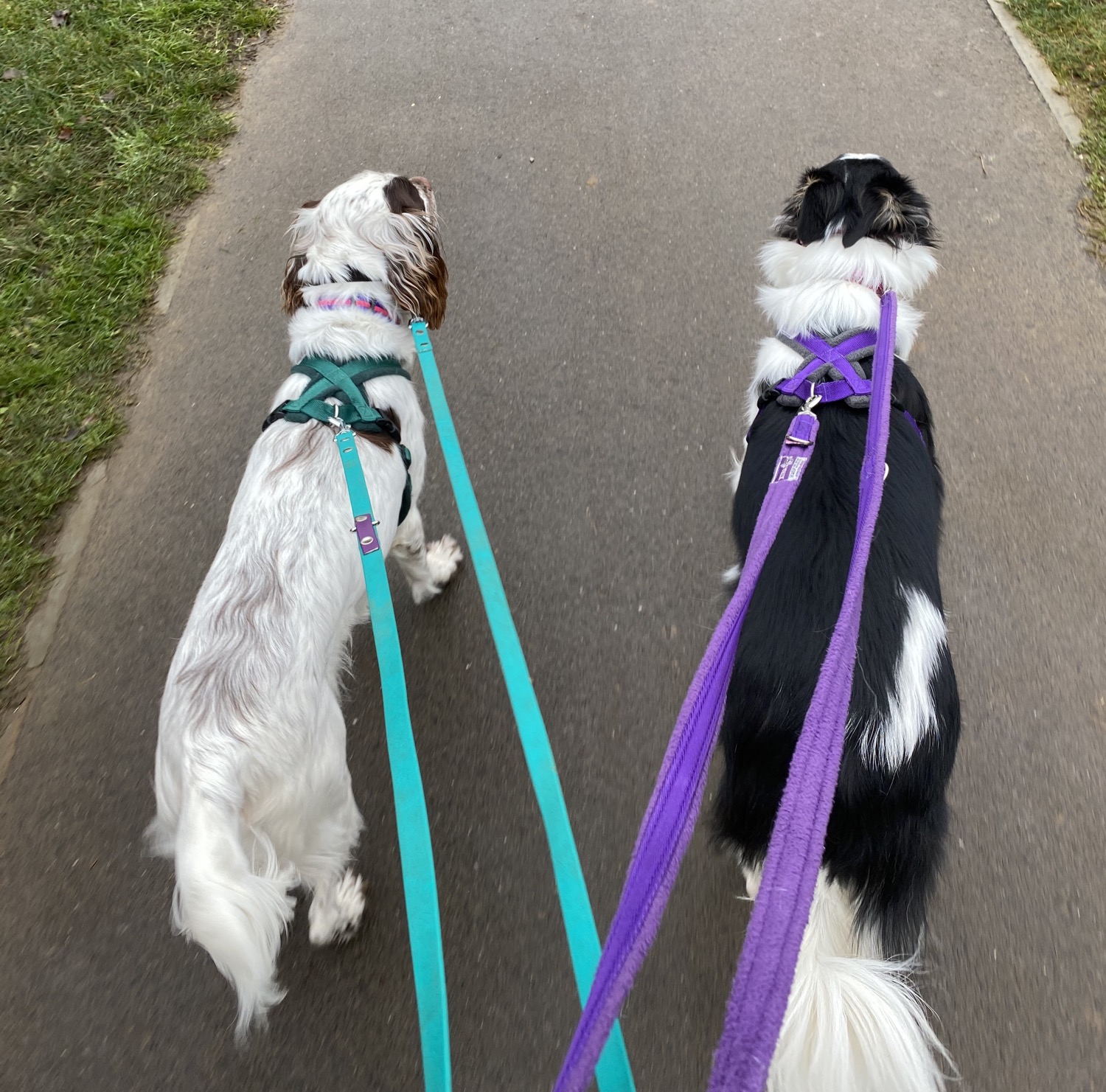
I own a dog selective dog, Rosie. She didn't used to be, but now she is. Her arousal levels escalate from 1-100 in a nanosecond, and this is mostly down to chronic pain. I know her triggers, I know what sets her off, and I know that when she's having 'off days', there is a reason for it.
When pain is involved, the threshold for reacting drops dramatically. Think of it less as her “choosing” to react and more like her nervous system being on a hair trigger—so something that would normally be a 3/10 irritation jumps straight to 100 because she’s already uncomfortable.
A few things that tend to matter most in situations like mine:
1. Pain changes everything about thresholds
Even low-level, chronic discomfort can make a dog:
less tolerant of other dogs
quicker to escalate
slower to recover
When she has “off days,” that’s a huge clue. It usually means the underlying pain is fluctuating (which is common with joint issues, soft tissue injuries, or nerve pain).
2. Management isn’t a cop-out—it’s essential
Since I know her triggers, the goal isn’t to “train through” them when she’s already at a 9/10. It’s to:
keep her under threshold as much as possible
avoid stacking triggers (multiple stressors close together)
Give her decompression time after stressful events
That might mean more distance from other dogs, choosing quieter walking times, or even skipping walks on bad days in favour of enrichment at home.
3. Training needs to match her physical state
On good days, you can work on things like:
calm disengagement from other dogs
pattern games (predictable routines that reduce anxiety)
Reinforcing check-ins and orientation to you
On bad days, the goal shifts to support, not progress.
4. Pain management is often the turning point
If you haven’t already, it’s worth exploring a really thorough pain workup with a vet—ideally someone experienced in chronic pain or rehab. Sometimes general exams miss things like:
subtle orthopaedic issues
muscular pain
early arthritis
nerve-related pain
Dogs who seem “behavioural” often improve significantly once pain is properly controlled.
5. Watch recovery time as a key metric
Progress isn’t just “did she react or not”—it’s:
How quickly she comes back down
whether she can re-engage with you
whether reactions are getting less intense over time
Cheery is a rescue dog who was found on the streets of Ireland. With no knowledge of her background, we have to work with the dog in front of us. And for months, the dog in front of us was explosively reactive. possibly through fear, possibly through frustration and possibly because of pain. Her owner has worked tirelessly to help her, never giving up, always listening to advice and following training plans to help her dog. Her progress has been incredible; it's not been fast, but changing the emotional response of a dog isn't easy or quick!
And this is what real, meaningful progress looks like—and it often gets overlooked because it isn’t quick or dramatic.
With a dog like Cheery, especially one with an unknown background, you’re not just “training behaviour,” you’re reshaping how she feels about the world. And when fear, frustration, and pain are all potentially in the mix, that’s a genuinely complex case—not something that resolves with simple fixes.
The fact that she went from explosively reactive to showing “incredible progress” tells us a few really important things:
She’s capable of learning and feeling safer
Her owner has built trust (which is huge for a former street dog)
The training approach is addressing emotion, not just suppressing behaviour
That last part matters most. Anyone can shut a dog down temporarily—but changing emotional response is what creates lasting change.
“We have to work with the dog in front of us” is exactly the mindset that leads to success in cases like this. No assumptions, no forcing a narrative about her past—just responding to what she’s showing now.
And the slow progress? That’s actually a good sign. Fast “fixes” in reactivity cases are often just:
avoidance without emotional change
suppression (which can backfire later)
Whereas slow progress usually means:
thresholds are genuinely shifting
Recovery is improving
The dog is building new associations, not just coping
Progress with dogs like Cheery & Rosie is rarely linear.
You’ll often see:
steps forward
sudden regressions
Then a new baseline that’s slightly better than before
Those “off days” don’t erase progress—they’re just part of the nervous system being temporarily overwhelmed (often by pain, stress, or trigger stacking).
What stands out most here isn’t just Cheery’s improvement—it’s the consistency and commitment of her owner. Dogs like this don’t make progress without someone:
paying attention to subtle changes
adjusting expectations day by day
advocating for the dog instead of pushing them past their limits
That’s rare, and it’s why she’s improving.
ROSIE CHEERY


Comments